Science in the Spotlight: mastitis and behavioural changes
Kristyn Maguire
Apr 22, 2026
Can changes in milking behaviour reveal health problems before clinical symptoms appear? New research supported by the Gustaf de Laval Fund suggests they can. The study examines how data from automatic milking systems may help identify mastitis earlier, giving farmers valuable insights to support herd health and decision-making.
What if cows could signal that they were developing mastitis days before any visible symptoms appear? New research suggests that, in many cases, they already do – through changes in their milking behaviour.
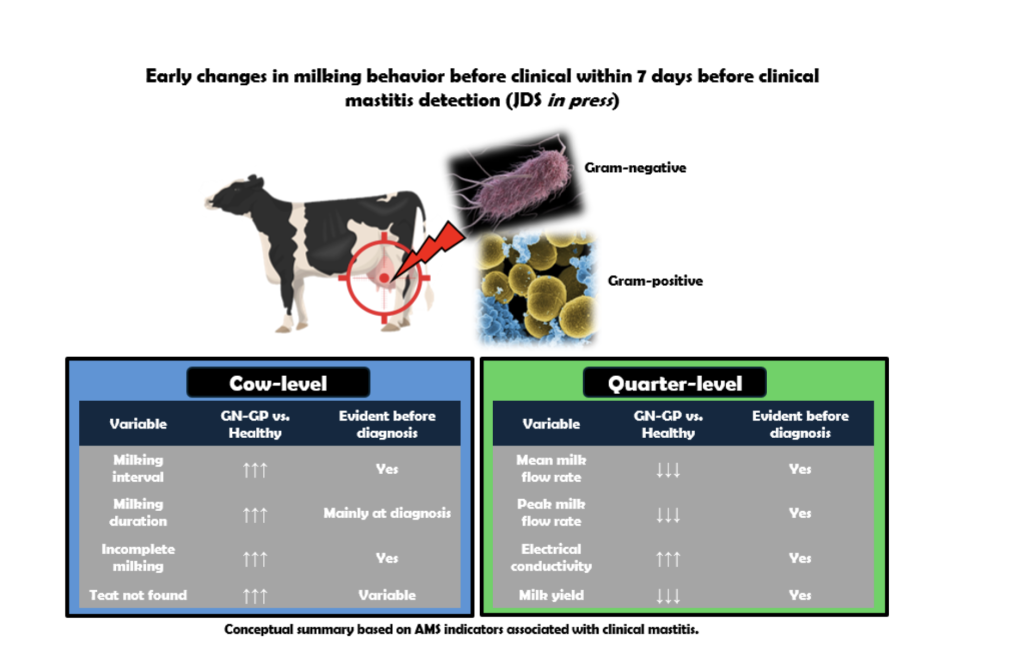
A study by Gustaf de Laval Fund recipient Pablo Muñoz Boettcher shows that cows milked in automatic milking systems (AMS) often change their behaviour during milking up to seven days before clinical mastitis is diagnosed. Published in the Journal of Dairy Science, the study adds important new knowledge on how data already generated by AMS can support earlier and better‑informed on‑farm decisions. Read more about his findings below.

His research question
Most mastitis detection methods rely on visible clinical symptoms or laboratory diagnostics. While effective, these approaches often identify the disease after it has already developed or involve a time delay between sampling and results.
Pablo’s research takes a different approach. Instead of focusing on symptoms or test results, the study asks whether mastitis can be detected earlier by analysing changes in how cows behave during milking.
This is a critical question, as mastitis remains one of the most common and costly health challenges in dairy production, affecting cow welfare, milk quality, and farm economics. Earlier detection is key to reducing its impact.
The study analysed nearly 50,000 milking events from Holstein cows milked with DeLaval VMS™ at Longs Peak Dairy in Colorado, USA – one of the largest automatic milking farms in the region.
The dataset included cows at different stages of lactation and compared:
- healthy cows, and
- cows developing clinical mastitis caused by different types of pathogens.
Key findings
The results show that:
- Both gram‑negative and gram‑positive infections alter milking behaviour, and in some cases these changes are detectable up to seven days before clinical diagnosis
- Gram‑negative infections lead to greater disruptions in milking behaviour and milk production than gram‑positive infections
- Changes are observed in milking interval, milk flow, incomplete milkings, and milk yield, with patterns differing across lactation stages
One of the most important findings of the study is that mastitis does not present as a single, consistent behaviour pattern. Instead, milking behaviour changes vary depending on the type of pathogen involved and the stage of lactation. In other words, the same clinical diagnosis – mastitis – can have very different behavioural signals, depending on what causes it and when it occurs.
Why this matters in an automatic milking environment
Automatic (robotic) milking systems such as our VMS collect detailed data at every milking – from milk yield and flow to milking intervals and incomplete milkings – for each cow and quarter.
The key challenge is turning this data into insight that supports day‑to‑day decision‑making on farm.
This is where digital solutions such as DeLaval Plus are particularly valuable. By bringing together data from the milking system and presenting it in a structured, actionable way, they help farmers and advisors to:
- Detect potential health issues earlier and respond more precisely
- Prioritise attention where it is most needed on farm
- Strengthen overall herd health management
- Make more informed decisions about treatment and follow‑up
Rather than reacting only once clear clinical signs appear, these tools support a more proactive approach – helping farmers act earlier, when there are more options to manage health challenges effectively.
Implications for DeLaval and the dairy industry
For DeLaval, the research strengthens the scientific foundation behind precision dairy technology. It demonstrates how data already produced by our systems can support better decisions for cow health and welfare when combined with robust research and analysis.
For the dairy industry more broadly, the findings contribute to ongoing efforts to:
- Improve animal welfare
- Reduce economic losses linked to mastitis
- Support more responsible antimicrobial use
- Make better use of digital farming tools
Importantly, the study also highlights the need for continued research. While behavioural patterns are increasingly clear, translating them into practical, farm ready decision support requires further development, validation, and collaboration.
You can read the full study here: Association between mastitis pathogen category and milking behavior and performance in Holstein cows in an automatic milking system
In short
- Cows change how they behave during milking when they are starting to develop mastitis.
- These changes can happen days before clear symptoms are visible.
- Automatic milking systems already collect this behaviour data.
- By understanding these patterns better, farmers may be able to spot mastitis earlier and act sooner.
About the researcher
Pablo is a Gustaf de Laval Fund recipient and a Graduate Research Assistant in the Department of Animal Science at Colorado State University. The Gustaf de Laval Fund is our research funding programme for master’s and PhD students, supporting academic research that addresses key challenges and opportunities in dairy production. Pablo’s research was supported through the 2023 programme, which focused on ‘Milking and housing cows for a sustainable dairy production’. His study is a strong example of how long‑term research funding can generate insights that benefit both DeLaval and the wider dairy industry.