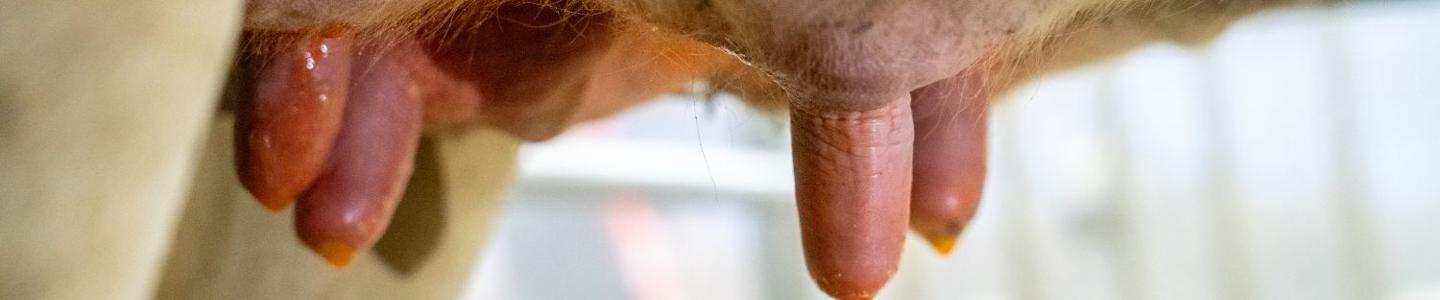
Udder health at Hamra Farm
Protect the udder, protect your milk: our approach in practice
Let’s talk about udder health. At Hamra Farm, we’ve spent many years systematically improving udder hygiene and reducing mastitis cases. It’s an ongoing process, and we’re still learning every day. But by following a structured approach, we’ve managed to keep our somatic cell counts at a level we’re satisfied with – around 110,000 to 120,000 per millilitre of milk. Here, we’ll share what we do, why it matters, and how the right combination of hygiene, milking settings, teat care and technology can make a real difference on any farm.
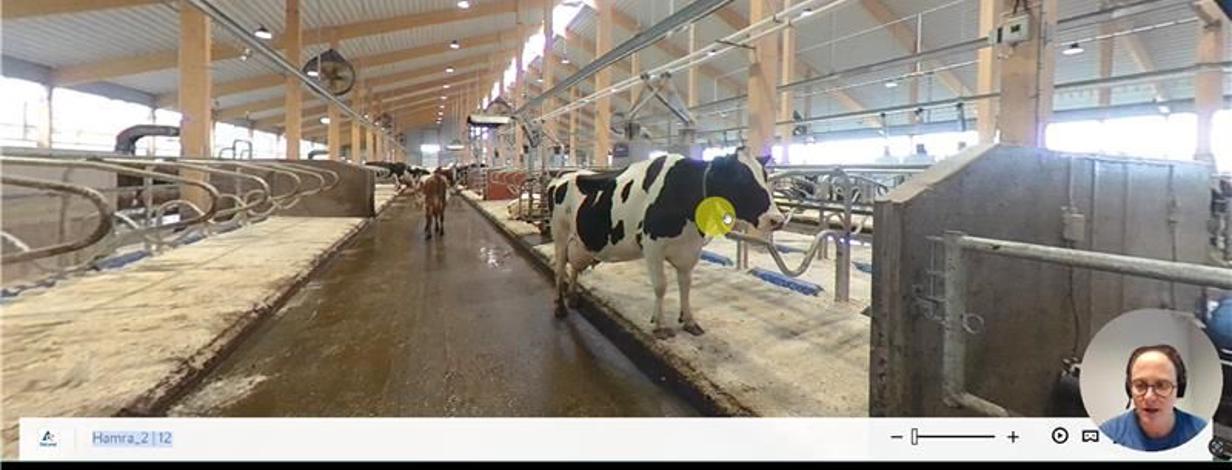
It all starts with a good plan
Maintaining good udder health comes down to solid planning and the right routines. So what did we focus on when designing the new VMS barn to best support this? In this video, Julie Geldolf, Market Solution Manager at DeLaval, walks you through how we planned the setup. We hope it inspires your own planning.
A quick udder‑health‑focused tour around the VMS Barn
In this video, Per Edstam, Market Solution Manager for Sweden, takes you inside the VMS Barn to highlight the practical steps our team is taking – and the technologies involved – to protect our herd’s udder health.
Daily routines that make a real difference for us
Udder health isn’t something we simply ‘check off’ a list – it’s woven into our daily routines.
It starts long before a cow enters the milking robot. It begins with the environment she lies down in, the air she breathes, and the routines she experiences every single day. Clean bedding, gentle milking, strong teat care, and real‑time monitoring – these are the pillars that support our herd’s health. Here are some of the ways we achieve this:
1. Creating a clean environment: clean, dry cubicles
Every day we start with the basics: hygience. Twice a day, each cubicle is cleaned, and sawdust is added once or twice daily to keep resting areas dry and inviting. A bedding‑drying agent helps control moisture. It’s a simple routine, but one that we’ve found has a big influence on how clean udders stay throughout the day.
2. Ventilation
Fresh air is another quiet hero in the barn. Good ventilation keeps humidity down and bedding drier, creating a healthier environment for cows and reducing exposure to bacteria.
3. Udder care
We believe much of our udder‑health success comes from the small, consistent routines that protect teat condition and ensure a smooth milking process. If we had to break it down into three focus areas, we would say teat dip, gentle milking, and good liners.
After every milking, we use a teat dip to protect the teat when it’s most vulnerable. The VMS™ also milks gently, attaching accurately and maintaining a steady, comfortable process that helps protect teat condition and reduce stress on the udder.
Plus, we have Flow‑Responsive™ Milking, which automatically adjusts the vacuum according to how much milk is flowing. This means the teats are never under more pressure than they need to be, supporting comfort and udder health.
We also rely on DeLaval Original VMS™ Liners because they fit the majority of our herd well. Over time, we’ve found that this consistent fit helps maintain teat condition and reduce irritation.
4. Continuous, real‑time insight
We build on our udder‑health routine by focusing on identifying issues early so cows stay healthy and productive. We keep a close eye on somatic cell counts – they’re one of the earliest signs that something isn’t quite right in the udder. When cell counts rise, it often means an infection is starting long before you’d see any visible symptoms.
With the DeLaval BioSensor Milk Cell Analysis (MCA), these counts are measured automatically at every milking. This type of digital service – along with others we use (which we’ll tell you more about later in the series) – gives us a clear picture of changes as they happen, so we can step in early and deal with issues before they turn into bigger problems.
5. Cow comfort and feed
A cow that feels good copes better with challenges – just like us humans, right? To support this, we prioritise calm spaces, plenty of fresh, high‑quality feed, and – of course – the DeLaval Swinging Cow Brush SCB for a good massage. When stress is low and nutrition is steady, the immune system stays stronger, giving cows a better chance of defending themselves against mastitis‑causing pathogens.
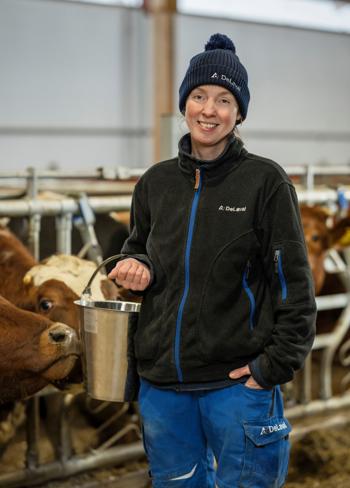
"We have been working in a systematic way for many years to strengthen udder health and reduce mastitis incidents and cell counts. The strategy has been successful, and today we are at an average level of 110,000–120,000 somatic cells per millilitre of milk.”
Linda Thulin, Herd Manager, Hamra Farm

Udder health
Good udder health is so important. After all, mastitis‑related diseases are the second biggest reason for culling cows in the herd. By keeping the environment dry and clean, and by avoiding contamination between cows, we can minimise the risk of mastitis. This helps keep cows in the herd for longer – contributing to a longer, more productive lifetime.
Our VMS set-up
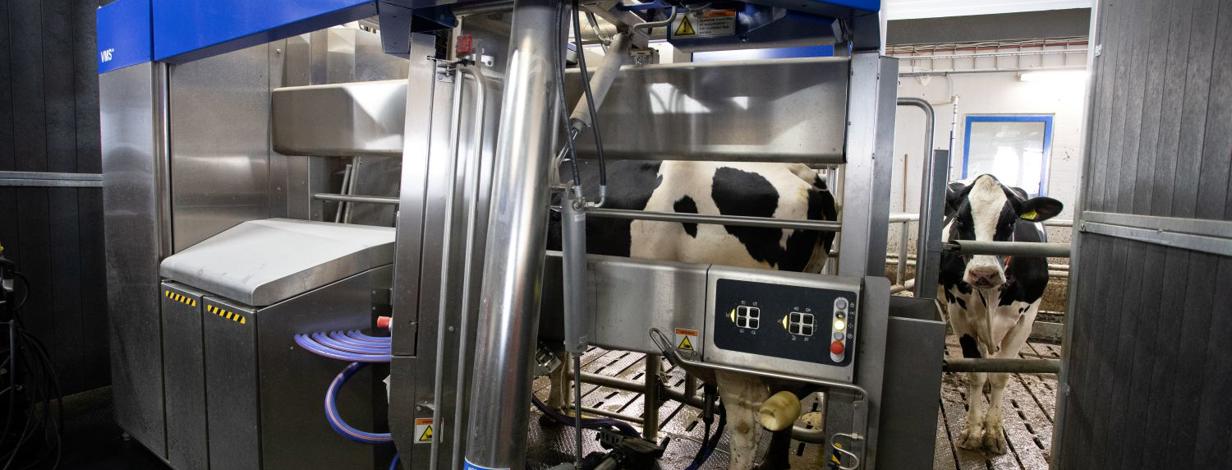
How robotic milking supports udder health at Hamra Farm
Let’s take a closer look at how we milk: our new VMS Barn at Hamra Farm features four DeLaval VMS™ V310 units and one DeLaval VMS™ V300.
For us, one of the key advantages of a voluntary milking system (VMS) is that our cows can choose when to be milked. This works well with their natural rhythm and lactation cycle, helping to reduce stress and support overall health. Plus, each quarter is milked independently: the VMS stops milking the quarter as soon as milk flow slows, so no quarter is over‑ or under‑milked – an important factor in preventing mastitis and maintaining milk quality.
Then there’s the attachment and cleaning. Each robot provides gentle, precise milking with intelligent teat cup attachment and thorough cleaning before milking begins. After milking, the system delivers consistent teat spraying for every cow, using the correct dosage for good coverage. We also know which settings and nozzles to use with each product, as every combination is extensively tested.
Flow‑Responsive™ Milking also plays an important role in how gently our cows are milked . Because the vacuum adapts to the milk flow from each cow — and each quarter — the system avoids unnecessary stress at the beginning and end of milking. We’ve seen that this contributes to more stable teat condition across the herd and supports the other routines we already rely on.
Let's talk teats: Understanding teat skin and why formulation matters
Before we talk about what we use, it helps to understand a bit of the science behind teat skin.
Teat skin naturally has a pH of around 5.5, which helps keep it soft, elastic, and resilient. When that balance is disrupted – or when the skin becomes dry or damaged – the teat canal becomes more vulnerable to bacteria.
That’s why teat dips are carefully formulated. They balance germicidal activity, viscosity, pH, and skin‑conditioning ingredients to disinfect effectively while supporting healthy skin. Each product we use has been tested in both laboratory settings and long‑term field trials. But even the best formulation only works when it’s applied evenly and consistently – which is where automated spraying really makes a difference.
Putting the science into practice
We use a teat spray right after milking because the teat sphincter stays open for around 30 minutes – often longer in high‑yielding cows – which leaves the udder more exposed to bacteria during that time.
To protect cows in this vulnerable window, we apply a post‑milking teat spray. In our case, that’s DeLaval Proactive™ Plus, a formulation that disinfects quickly while caring for the skin. The VMS™ V300 applies it at the correct dosage every time, ensuring even, reliable coverage. Achieving that level of consistency manually is difficult, and automation has been key to maintaining good teat condition and overall udder health.
Our top five essentials for teat care:
• Good disinfection: The teat spray must kill bacteria effectively.
• Skin conditioning: Emollients keep the skin flexible and prevent cracks.
• Consistent coverage: Automation ensures no teat is missed.
• Seasonal adjustments: Extra conditioning in winter protects the skin from cold and wind.
• Automation and efficiency: Robotic spraying supports mastitis prevention and reduces labour.

Constantly checking our somatic cell count
Somatic cell count (SCC) is one of the earliest signals that something may be changing in the udder because SCC rises when the cow’s immune system starts responding to irritation or infection. In other words, the body sends more white blood cells into the milk to protect the udder long before you see obvious signs of mastitis.
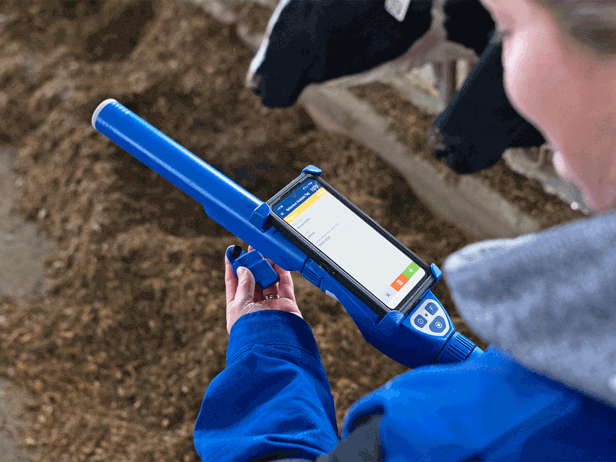
To track this, we use DeLaval BioSensors Milk Cell Analysis (MCA), which analyses milk at every milking to give us real‑time SCC information. With this data, we can act quickly: if a cow shows rising levels, we take samples, move her if needed, and review her status.
That quick response has helped us limit the spread of mastitis and reduce the need for antibiotics — good for the cows, good for the system, and good for the milk.
To sum up: our udder health philosophy
Ultimately, everything we do at Hamra Farm — from cleaning cubicles to adjusting vacuum levels — works together. If we had to leave you with four important takeaways, we’d say:
• Clean, dry resting areas: twice‑daily cleaning, fresh bedding, and weekly lime in the old barn.
• Effective teat spraying: consistent post‑milking protection.
• Correct milking settings and liners: protecting teat ends during every milking.
• Advanced technology: use digital tools that help you spot problems in real time, so you can act early, not late.
These routines help prevent mastitis, keep cows comfortable, and maintain the milk quality we aim for every day.
Next up
In future posts in our Hamra Farm series, we’ll look more closely at BioSensors, Flow-Responsive™ Milking, and practical tips for choosing liners and teat-care products.