Linda Thulin: Building a career – and a herd – at Hamra Farm
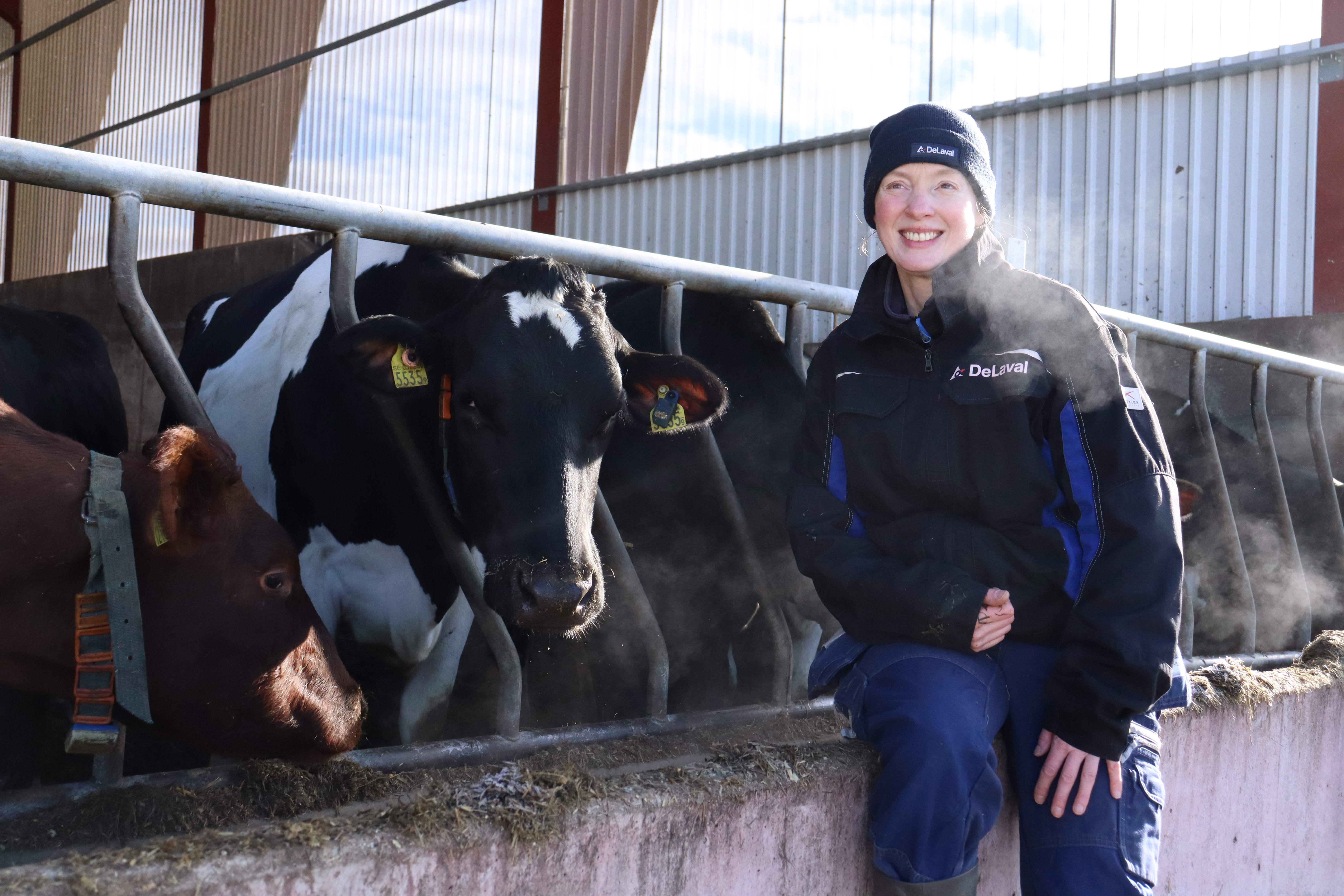
To mark International Women’s Day and kick off the United Nations International Year of the Woman Farmer (IYWF 2026), we are sharing the stories of women who are shaping the future of farming.
We begin with Linda Thulin’s story – herd manager at DeLaval’s Hamra Farm. It’s a story about turning an early love of animals into a career, and about building something lasting: a herd, a team, and deep expertise grounded in knowledge and experience. At DeLaval, she inspires us every single day.
“Quite early on, my neighbours noticed my huge interest in animals. I was always the first one they asked to take care of their cats, rabbits and other small pets when they went away for weekends or holidays.”
Some people are born into farming. Others find their way there – step by step, animal by animal, responsibility by responsibility.
Linda belongs to the second group. Raised in a suburb just outside Stockholm, Sweden, she followed her love for animals all the way to Hamra Farm, where she has spent more than two decades helping to build one of Sweden’s most well-known dairy herds.
Arguably, her love of animals – and, ultimately, her career path – can be traced back to a single budgerigar.
“My oldest sister brought a budgerigar into our family, and it quickly became a much‑loved part of our home. The little bird was so clever and funny, and even learned to say a few words. Before long, my neighbours noticed how interested I was in animals. I was always the first one they asked to look after their cats and rabbits when they went away."
When she was ten, her sister introduced a much bigger animal into her life: a horse.
“Every day, I followed her to the stables after she finished work. It meant late evenings for me – but I did my homework after school, ate something simple, and then spent time with the horses. I learned to appreciate both hard work and a good night’s sleep. Most weekends were spent at the stables too."
"If I wasn’t in the stables or looking after neighbours’ animals, I was drawing or writing. So when it was time to decide on a direction for my future, I had two dreams: one centred on animal care, and one on writing and drawing.”
When it came time to choose her path in upper secondary school, Linda chose to follow her passion for animals and farming, enrolling in a programme focused on basic agriculture. *In Sweden, students apply to a specific programme and spend three years studying that field as part of their high‑school education.
“My plan at that point was to go straight to work after school, spend a year or two on a few different farms, and then continue on to agricultural college.”
She sent job applications to farms across the Stockholm area. The first reply she received came from Hamra Farm. In hindsight, that reply marked the beginning of exactly the right path – as if it had been written in the stars.
However, she still faced a hurdle: proving herself.
“At my first interview, someone commented on my body size and questioned whether I would be strong enough for the job. Of course, that made me feel unsure, but it also gave me a strong determination to prove myself.
“But the team of cattlemen were incredibly kind and supportive. I learned so much from them.”
After two years at Hamra Farm, with no thoughts of moving on to another farm, Linda felt the need to return to school. To qualify for agricultural college, she needed higher‑level studies in mathematics, chemistry and physics, which led her to a school in central‑northern Sweden.
Living and studying in central‑northern Sweden meant being hours away from home. Isolated from her family, she realised she didn’t want to continue studying away from them — a decision that also meant she wouldn’t pursue an agricultural university degree, as that would have required living far from her family too.
She knew there was no shame in changing her plans. Wanting a solid base close to her family, she adjusted her goals and chose to continue her studies in Stockholm, shaping a future more firmly centred on home and family.
Moving back to Stockholm also meant choosing a different degree path. Linda opted for biology and immersed herself fully in academic life. She discovered a deep fascination with her field of study and began to imagine a future in research, dreaming of becoming a scientist: spending years out in nature, searching for answers, identifying patterns, and developing deep expertise in her field.
“I got into college life and loved it. I wanted to earn a master’s degree in biology and started to dream about becoming a scientist – spending years on exciting field trips in nature, trying to find answers, recognising patterns, becoming an expert and digging really deep into specific experiences.
“During my final year at university, I completed my master’s thesis at the Zoological Institute. That was my goal. I carried out DNA analyses in the laboratory, and my results were used in two published articles. It was my first step towards a potential doctoral position.”
But she wasn’t happy. That year at the Zoological Institute was very lonely – alone in the laboratory, alone in the library, alone at my desk writing: “It wasn’t the way I had imagined a researcher’s life.”
Alongside her university studies, Linda worked weekends at Hamra Farm to support herself and afford her apartment, a car and her horse.
During that time – around 2005 – Hamra Farm was undergoing a period of major transformation. The operation was growing and evolving, with a new calf building, a new barn for VMS milking combined with a commercial showroom, more cows, more employees, extensive testing, and a steady stream of visitors.
As the farm expanded, the herd manager at the time, Henrik Norberg, needed additional support and asked Linda if she would consider stepping into a shared leadership role – not as a second herd manager, but as a manager with clearly defined areas of responsibility. It was an opportunity she couldn’t turn down.
“Taking on personnel responsibility was challenging, and it took me a year or two to feel comfortable in that role. For ten years, I worked side by side with Henrik as joint herd managers, and I grew enormously during those years. There was never any thought of changing direction. After those ten years, I felt ready to take on the role of herd manager on my own (2015). I don’t want to be anywhere else – Hamra Farm is my place to be.”
After more than 20 years at Hamra Farm, what makes her stay?
She says it’s the uniqueness of the place – and of the role itself.
“Hamra Farm is such a unique place to work. My role as a herd manager here can’t really be compared to many other roles. It’s the combination of traditional dairy farming, a large team of employees, constant testing of new equipment, and people from different backgrounds and educational fields coming in to learn, install systems, and test new solutions.
“There are so many meetings, with different perspectives and different ways of thinking. And because the farm also functions as a showroom, we can’t afford to make a mess – we have to stand out as a good example. We have to be good at what we do.”
Hamra Farm itself also continues to evolve. One clear example is the major expansion completed in 2025, reinforcing the farm’s role as both a working dairy and a showcase for innovation. For Linda, that constant development is a key reason she stays – and why the future still feels exciting.
Factbox: Hamra Farm combines commercial dairy farming with the constant testing of new equipment, and a steady flow of people from different backgrounds and disciplines. Visitors come to learn, install systems, and evaluate new solutions. As a working farm and a showroom, it is expected to set an example – to be orderly, professional, and consistently high performing.
What she values most is the balance this type of work brings.
“I really like the balance in my work – between physical work out in the barn and administrative work in the office. Between daily planning and long‑term planning. Sometimes you have to make decisions very quickly, and sometimes you can take your time and think things through.
There is joy in letting the animals out in spring, and then, in the harsh autumn weather, feeling safe and comfortable when everyone is back inside again. You feed a newborn calf for the first time and feel the bond begin to form. You get your hands and knees dirty fixing a broken manure scraper. You help a sick animal recover – and sometimes, despite everything, she doesn’t. You experience life and death in a very real way.”
“I really like the bigger picture. I work with a herd, and I’m building a strong, high‑producing dairy herd. I have a breeding strategy, a feeding strategy, and a management strategy for cow traffic, daily routines and key performance indicators.
There are daily follow‑up lists, weekly follow‑ups, monthly follow‑ups, and so on – and lots of people around me helping to make it all work. Sometimes I feel like the spider in the web.”
At the same time, it’s the small, quiet moments that matter just as much.
“Sometimes I like to get lost in the moment for a second. You pass a cow, make eye contact – you know her, and you can see that she knows you. There’s a quiet conversation in my head: ‘Hi, Hi! How are you? I see you. I’m glad to see you’re okay. I have to move on.’ And my heart feels a little warmer. Something is exchanged through that eye contact.”
What kind of person do you need to be to do this work? Linda believes it comes down to mindset as much as skill.
“You have to be able to see and understand individuals – animals, people and machinery. You need to appreciate days filled with routines that look the same every day, mixed with things you can never plan for. You have to enjoy using both your body and your mind, and not be afraid of getting dirty – especially if you also find satisfaction in making things tidy.
“Cows are amazing, wonderful, lovable creatures. This isn’t just a job – it’s a lifestyle. And I believe that this lifestyle keeps you strong. I’ve been at Hamra Farm for most of my life, and I’m so grateful for that.”