Planet
Highlights
We have set new global sustainability targets, supported by coherent plans across operations and product management and development, that will guide our sustainability development through 2030 and towards 2050.
The 2022 GHG emissions baseline was updated with more granular calculation methods, improving accuracy and helping to identify the areas where reductions will have the greatest impact.
We upgraded the DeLaval VMS™ V300 series, which now includes the Flow-Responsive™ Milking system. It adapts to each cow’s natural milk flow and ensures a smoother milking process and shorter milking times, which in turn increases productivity.
Targets 2030
Our updated targets for the focus area Planet.
0%
Reduce GHG emissions
0%
Total waste reduction
0%
Hazardous waste reduction
0%
waste recycled or reused
0%
Electricity production on site
0%
Renewable or low-emissions electricity
For future generations
Environmental sustainability is the ability to maintain balance, ensuring that resources are used wisely so that future generations can meet their own needs. It is essentially about living in harmony with nature without depleting its capacity to regenerate. It is about long-term survival and well-being through the responsible management of finite resources.
Our environmental efforts are rooted in the planetary boundaries framework, a science-based model that defines the environmental limits humanity must respect in order to maintain a healthy and sustainable planet. These principles help guide our actions as we work to reduce our environmental impact and support a more sustainable future for our industry and the planet.
We focus our efforts on four key areas:
- Greenhouse gas emissions
- Energy efficiency
- Waste and recycling
- Circularity
Targets 2030
During the year, we have set a wide range of new targets across the organisation. Most of them are set for 2030, with some extending to 2050. They include both major ambitions and smaller improvements across all our key areas.
Greenhouse gas emissions
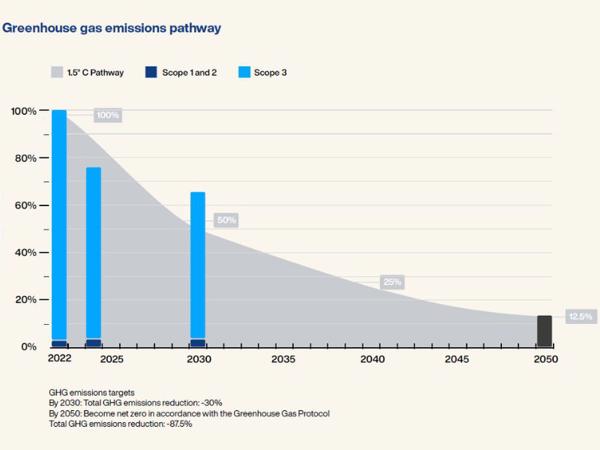
A 30% reduction in total GHG emissions by 2030 and reaching net zero in accordance with the Greenhouse Gas Protocol by 2050.
Energy efficiency
Energy optimisation: identification and implementation of initiatives each year equivalent to two percent of the previous year’s energy consumption during 2025–2030.
Renewable electricity with and electricity with low emissions: 60% renewable or lowemissions electricity, verified through credible certificates and with a disclosed energy mix.
Electricity production on site: 20% coverage of total electricity consumption through on-site electricity production.
Waste and recycling
Total waste reduction: reducing 15% of waste during 2025-2030.
Hazardous waste reduction: reducing 15% of hazardous waste during 2025-2030.
Recycling of waste: 0% waste to landfill and 80% of waste recycled or reused.
Circularity
Circularity of packaging: establishing a baseline for reductions, developing clear guidelines, and subsequently setting reduction targets.
Sustainable material: exploring and evaluating areas with high potential benefits, followed by setting reduction targets in prioritised areas.
Life Cycle Assessment: conducting life cycle assessments (LCA) for core products and solutions within DeLaval.
Initiatives 2025
In parallel with creating new targets, we have also acted on our newly set goals and undertaken a range of initiatives during the year.
One of our key initiatives during 2025 has been to integrate sustainability criteria into our product development. This process now supports the setting of sustainability targets for every new project and upgrades of current products. Which enables us to evaluate the impact of each new product or upgrade.
Our greenhouse gas emissions
We calculate our emissions in accordance with the GHG Protocol and include most Scope 1, 2, and 3 categories. Our approach also covers emissions from our adjacent businesses.
Scope 1 Own emissions:
Own emissions direct from our operations.
Scope 2 – Indirect emissions:
Indirect emissions from purchased energy that power our operations.
Scope 3 – Value chain emissions:
Value chain emissions that encompass indirect sources across our value chain. These include all emissions that occur outside our own operations but are still connected to the products and services we provide, such as those from suppliers, transportation, product use, and end‑of‑life treatment. The vast majority of our greenhouse gas emissions are indirect and it is within scope 3 where we can make the biggest difference.
A new pathway towards net zero emissions
Greenhouse gas (GHG) emissions are a key factor driving climate change. We are committed to reducing our emissions to net zero and contributing to the global efforts to operate within the scientifically defined planetary boundaries, while supporting more sustainable dairy farming.
We established our greenhouse gas emissions baseline in 2024. It is based on our 2022 emissions data, calculated using the GHG Protocol accounting standard. By setting this clear starting point, we have built a solid foundation for our sustainability journey.
In 2025, we updated our baseline to enable more robust and precise calculations. We now use a more refined methodology, incorporating input from multiple product owners, and have expanded the scope to include categories that were previously excluded due to limited data availability.
By refining how we measure and report emissions, we can identify the areas where reductions will have the greatest impact. This results in clearer priorities. We now have a stronger understanding of which parts of our operations and value chain contribute most to our overall footprint.
“Now that our baseline measurement of our entire GHG emissions has been updated and even more granular, we are focused on continuing to define our actions plans throughout the various departments, to reduce those emissions.”
– Maria Collin, Head of Group Sustainability
Our pathway
With our new 2022 baseline as a starting point, we have defined a clear pathway towards our long-term goal of net zero emissions by 2050. Our newly defined targets translate this pathway into practical action.
While our ambitions are high, current progress suggests that we are moving in the right direction:
- Our 2022 baseline set total emissions at nearly 1 million tonnes of GHG.
- The 2024 results (including adjacent businesses) showed a reduction to 0.7 million tonnes.
We will continue to measure emissions annually and closely follow up on results to ensure continued progress.
Partnership supporting a net zero dairy industry
The Milk Sustainability Center is an online platform developed through a joint effort with John Deere initiated in September 2023. The Milk Sustainability Center empowers farmers to optimize their operations, reduce environmental impact and become more profitable.
The updates made during 2025 cover both marketing, partners and product development. Key updates include:
- Making the center available in 13 markets.
- Translating the platform into nine languages.
- Expanding the number of farm software systems that can be connected to 30.
- Making guided demos available on the website.
- Establishing compatibility with feed software.
Automating the enrollment process for dairy farmers, thereby lowering the threshold for participation. In addition, feedback has been gathered from participating farmers to gain a clearer understanding of their needs and priorities.
Product development reducing CO₂e impact
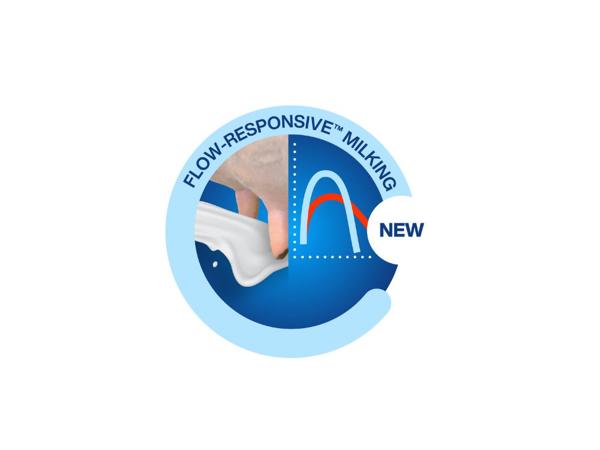
In 2025, our DeLaval VMS™ V300 series was upgraded to include several technical enhancements, most notably the integration of our Flow‑Responsive™ Milking system.
The system adapts in real time to each cow’s natural milk flow. By automatically adjusting key parameters such as vacuum level and pulsation, it ensures a smoother milking process and shorter milking times, which in turn increase productivity.
Higher productivity means that the same resources and emissions are distributed across a larger volume of milk produced. This can result in a reduced CO₂e footprint per kilogram of milk and may also contribute to lower overall greenhouse gas emissions from dairy production.
Responsible water use
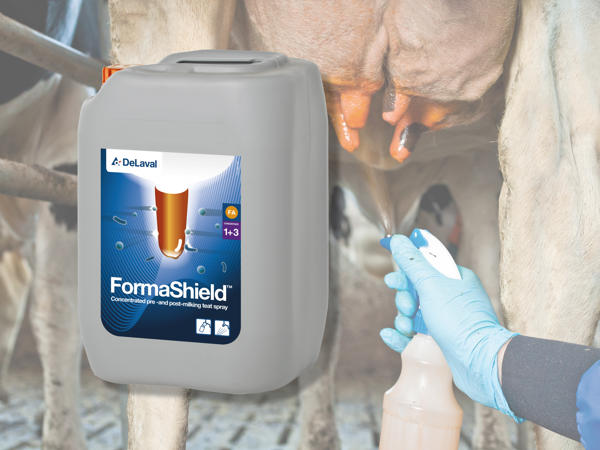
At the Des Plaines chemical factory, we updated the softener equipment. This allows us to track softened water usage over time, providing historical batch data and supporting improved process control.
We also revised our soft water testing process to reduce water usage by 92–95%, from approximately 250–400 gallons to less than 20 gallons per test.
Additional initiatives
Lowering emissions by switching refrigerants in condensing units, with the new type lowering the GWP level from above 2500 to 150.
Introducing multi-use packaging for VMS components between Poland and Sweden.
Purchasing energy from renewable sources. Implemented in many European countries. Planned for America and China.
Optimising the utility equipment running time to better match production needs, as the equipment does not need to run continuously, thereby reducing power consumption.
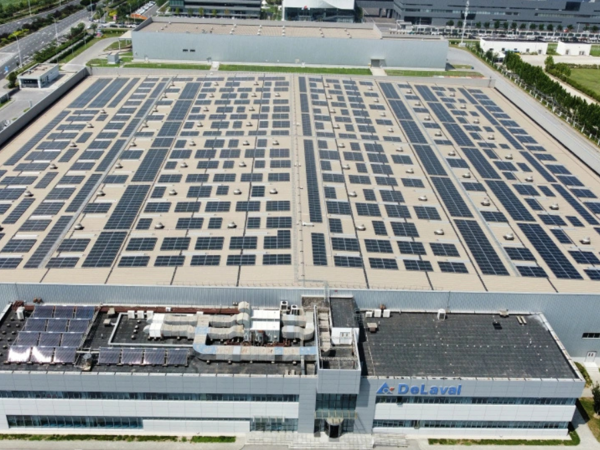
Installing photovoltaics on the rooftops of several buildings at different sites.
Reducing electronic waste through the Reuse Function, where DeLaval’s used PC’s are sent to Atea to be professionally refurbished and resold.
Monitoring volumes in sea freight to reduce shipments.
Using Iron pallets for transportation to reduce the usage of wooden pallets.
Implementing paper free operations in Argentina, including pick/pack and transport documents.
Other initiatives include reducing paper by using a digital Daily Control Board, optimising packaging design and print, upgrading to more energy‑efficient air compressors, repairing air leaks, and improving packaging solutions to lower the need for wooden cases.
Eco-design study by two master’s thesis students, focusing on minimising material use, environmentally friendly materials, and product modularisation.
Case Study
Milking parlour retrofit enables sustainable modernisation in China
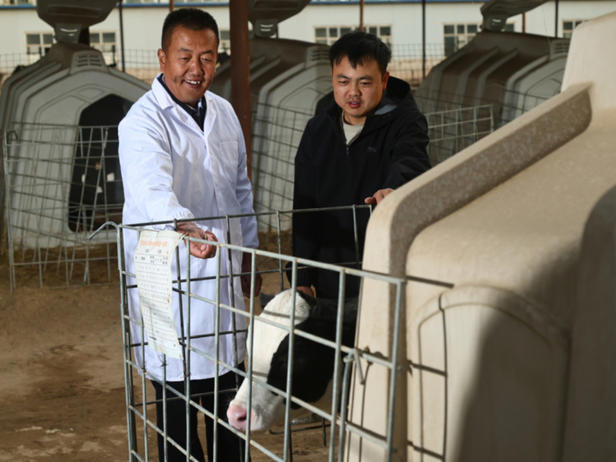
At a Xinjiang Terun Dairy farm in China, we helped the customer extend the life of a 20-year-old parallel parlour while improving milking efficiency, animal health, and access to data. The project shows how older installations can move step by step into the future without the need for a full replacement. A benefit for both the farmer and the environment.