A word from our CEO
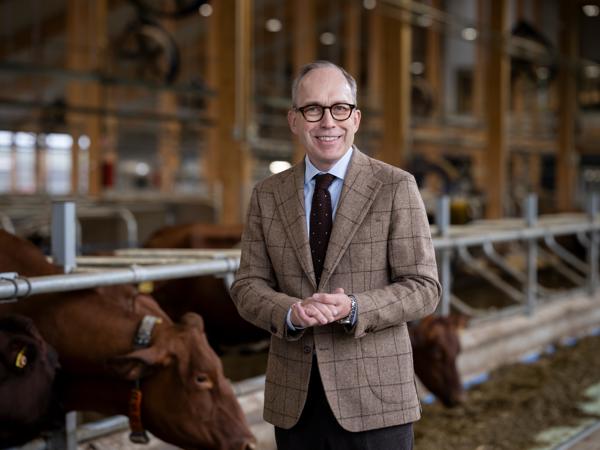
Sustainability is at the heart of everything we do at DeLaval. It shapes our development and guides our responsibilities across the organisation as we strive to lead the dairy equipment industry. Through our solutions and services, we enable more sustainable dairy production and help farmers meet the growing global demand for food.
For us, it is not just a responsibility, it is also a meaningful business opportunity. Sustainability strengthens our resilience as a company and helps the dairy industry become more sustainable, profitable and future‑ready by creating value that balances environmental, social, and economic priorities.
We are committed to supporting our customers in improving productivity through a strong focus on animal welfare, increased automation and safe working conditions, while minimising negative environmental impact and strengthening social and human rights.
In one way, our aim is rather simple: a healthy, comfortable cow produces more milk, and healthy cows deliver better results. Higher productivity and strong animal welfare go hand in hand. Our solutions help dairy farmers improve cow health and longevity, which in turn increases milk yield per cow and reduces methane emissions per kilogram of milk. That is also an improvement for the planet and the people living on it.
“Our solutions aim to help dairy farmers improve cow health and longevity, enhancing milk yield per cow while reducing methane emissions per kilogram of milk. That is also a win for the planet, and the people living on it.”
Innovation through collaboration
We do not have an isolated sustainability strategy. Instead, it is embedded in our overall company strategy and based on our vision ‘We make sustainable food production possible’. Our innovations act as enablers, shaping our sustainability focus areas and reinforcing our commitment to a sustainable dairy industry together with our customers and industry stakeholders.
Partners such as the Global Dairy Platform, the International Dairy Federation, and John Deere are just a few examples of the industry actors we collaborate with, because we know that sustainability challenges cannot be solved in isolation. By working together, we can reduce emissions, improve sourcing practices, and share innovations that make a difference at scale.
Alongside this, the work we do internally through our Global Sustainability Group, our Responsible Sourcing Programme and other initiatives, ensures we address challenges proactively rather than reactively.
From strategy to action and impact
Last year our focus was on translating strategy into action. In 2025, those actions have matured and are delivering tangible impact. Through our solutions, services, and ways of working, we are moving beyond intent to actively enable more sustainable dairy farming. Our daily work directly influences how milk is produced on farms around the world.
By enabling higher productivity through improved animal welfare, smarter use of data, and increased automation, we help farmers reduce emissions from milk production while strengthening the long-term viability of their operations. This is where our greatest impact lies, and it is how our actions contribute to a more resilient, efficient and sustainable dairy industry. We have made significant improvements at our factories and distribution centres, particularly in packaging and renewable energy sourcing, as well as launching different safety initiatives and lifting the sustainability competence internally.
Our people and culture initiatives have reinforced equality and inclusion during the year. After reaching our goal of 25% female employees and managers in 2025, we worked on identifying and addressing gaps in our 2030 gender diversity goal of 30%. We also prepare for the EU Pay Transparency Act, which aims to promote gender pay equality and transparency. Together, all these efforts have strengthened our effectiveness.
Updated GHG emissions baseline for a more detailed analysis
During the year, we updated DeLaval’s greenhouse gas emissions baseline to gain a more accurate and comprehensive understanding of where emissions actually occur across our operations and value chain.
With a clearer and more reliable picture of our starting point, we can set more relevant and measurable targets, track progress with greater confidence, and focus our efforts where they will have the greatest impact. This provides a solid foundation for our pathway towards achieving net zero by 2050.
Sustainability as a long-term responsibility
Despite geopolitical uncertainties and a changing global context during 2025, we remain focused on our long-term sustainability ambitions. Sustainability is part of our vision and embedded in our core business strategy. While external conditions may evolve over time, our direction and commitment remain firm.
Looking ahead, we will continue to direct our innovation efforts towards selected, highimpact areas and work more closely with partners across the value chain. Strong governance, clear targets, and collaboration remain essential, and we will keep a holistic perspective that balances environmental, social, and economic priorities.
We will keep our focus on our customers and how we can help them increase productivity and profitability through improved animal welfare and smart innovations. Being an enabler is not just a statement, it is a responsibility that guides our actions every day to make sustainable food production possible.